


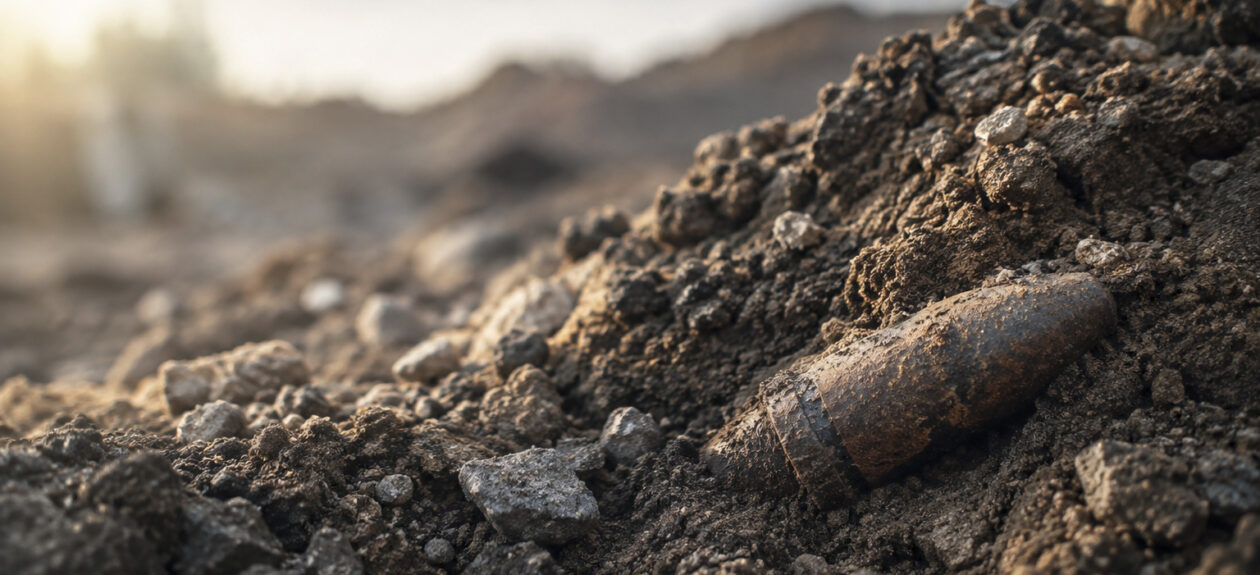
More than 80 years have passed since the end of the Second World War, yet its legacy continues to affect the construction industry in Germany. Extensive aerial bombing during the war means that unexploded wartime ordnance may still remain underground — and continues to be discovered today. This includes unexploded aerial bombs, mines and other explosive remnants of war.
Unfortunately, Germany has experienced tragic incidents involving unexploded ordnance. In 2021, an approximately 250 kg Second World War aerial bomb exploded during drilling work near the Donnersbergerbrücke railway junction in Munich.[1] Four people were injured, one of them seriously, and rail services were temporarily suspended. A similar tragedy occurred in Euskirchen in January 2014, when an explosion involving unexploded Second World War ordnance killed an excavator operator and injured a further 13 people.[2]
At Latvijas Energoceltnieks, we have also encountered this risk, having discovered suspicious objects that could potentially contain explosive material on several occasions. One example involved construction work on a residential street in Hamburg, where remnants of ammunition were found. Work at the location was suspended, the area was cordoned off and the relevant emergency services were called in. In this instance, a specialist was already nearby because the area had previously been identified as posing a potential, albeit relatively low, risk. Specialist support was also required during construction work in the vicinity of Ludwigslust in Mecklenburg-Western Pomerania. In areas where a potential hazard was known to exist, experts carried out thorough ground inspections and controlled excavation before construction work could resume.
Considerable efforts have, of course, been made over the decades since the war to survey affected areas and neutralise unexploded ordnance. Nevertheless, it is impossible to guarantee that every potentially hazardous location has been identified and inspected. Consequently, unexploded wartime ordnance remains a potentially high-risk hazard during any ground excavation or drilling operation, including the installation of underground telecommunications infrastructure.
Risk Assessment Begins at the Design Stage
Before construction work is planned, it is essential to establish at the design stage whether unexploded ordnance may be present at the site. This involves analysing historical aerial photographs and other archival records to identify locations that may have been bombed. Once the historical evidence has been assessed, a decision can be made as to whether more detailed investigations and on-site surveys are required.
Historical aerial imagery is particularly important in areas where traces of earlier bombing or bomb craters are visible, as these may indicate that explosive ordnance remains underground. Even the discovery of ammunition remnants alone may point to previous military activity and indicate the need for a more thorough assessment of the surrounding area.
If a company is responsible for designing a construction project, it must ensure that the necessary investigations are carried out, engaging specialist contractors where required. If, however, a company acts as the construction contractor and the project has been designed by another organisation, it must obtain information about known risks and the safety measures required before work begins.
How Is Work Carried Out in High-Risk Areas?
The level of specialist supervision required depends on the assessed level of risk. In low-risk areas, the presence of a specialist may be sufficient, allowing the construction contractor to carry out the excavation work. However, where unexploded ordnance is suspected, qualified ordnance detection and disposal specialists must be involved in planning and carrying out the work. They remove the soil gradually, layer by layer. Before each subsequent layer is removed, the exposed soil and excavation surfaces are examined using appropriate detection equipment. Work may proceed only with the authorisation of the responsible specialist and in accordance with the applicable safety requirements.
In certain circumstances, depending on the level of risk, construction machinery may require additional protective equipment, such as reinforced protective glazing or steel protective structures.
Impact on Project Schedules and Costs
Engaging specialist contractors, conducting thorough site inspections, providing supervision and, where necessary, modifying construction machinery all involve additional costs and longer project timelines. Work productivity decreases by 50% when a specialist supervises the work and by 90% when specialists also carry out ground probing and excavation.
Although these measures can slow down construction and increase costs, the safety of people will always remain the overriding priority.
People’s Safety – The Top Priority in Every Project
Although working in areas where unexploded ordnance may be present can require more time, additional resources and more meticulous planning, safety is never negotiable under such circumstances. The safety of people has always been our absolute priority, wherever we work — both that of our employees and that of the surrounding communities. Accordingly, whenever a suspicious object is discovered, stopping work, securing the area and involving the relevant specialists are integral parts of our working practices.
Author: Kaspars Reinholds, Director of the Telecommunications Network Department at Latvijas Energoceltnieks
[1] Vier Verletzte nach Explosion
[2] Nordrhein-Westfalen: Blindgänger explodiert in Euskirchen – ein Toter | DIE ZEIT
Image for illustrative purposes only


